Catgirl Heroes
Rulebook
Disclaimer: This game uses AI art
Objective
The game takes place in a fantasy city and its surroundings, in an imaginary era somewhere between swashbuckling and steampunk, for 1-4 players. The players take the role of Questgivers, assembling parties of adventurers for dangerous and difficult quests.
At the end of the game, the Questgiver with the most success wins.
Components
- 44 Hero cards (tarot size)
- 96 Quest cards (poker size)
- 4 Questgiver cards
- 8 "5" point cards, 8 "10" point cards, 8 "20" point cards
- 1 First Player card
- 16 Achievement cards
Hero cards:
Each Hero has an Alignment: either Valiant (white banner) or Wicked (black banner). But even if they are Wicked, it does not mean that they are villains. They work on the same goals as the Valiant ones, they just prefer to think that the end justifies the means.
A Hero's Alignment is shown in the upper right corner of the card. Other than it being Valiant or Wicked, it also contains a specific personality Trait that they find especially agreeable. This will matter when they decide how much they like working with certain Questgivers.
Towards the bottom of the Hero card, their Class is marked with a horizontal colorful line. Each Hero may belong to one or more of 4 Classes.
Besides their Class, they may have an Innate Skill that they always possess without the need of playing a card for Experience (see later).
Four Skills belong to each Class. The Classes and the Skills are:
- Green: Rogue - Stealth, Survival, Lockpicking, Perception
- Purple: Noble - Intrigue, Diplomacy, Charm, Etiquette
- Blue: Scholar - Engineering, Investigation, Academics, Strategy
- Red: Warrior - Athletics, Marksmanship, Swordfight, Endurance
A Hero that has "Magic" as Innate Skill is a Mage.
A Hero that has more than one Class is a Sentinel.
Note that a Hero can be both eg. a Rogue and a Mage at the same time. A Sentinel with eg. a green/blue Class line is both a Rogue and a Scholar in addition to being a Sentinel.
Sentinels don't have Innate Skills, but they can use Experience from each of their Classes.
Mages and Sentinels have no Trait. Their Alignment banner has gold edges only to make them easier to spot during Setup.
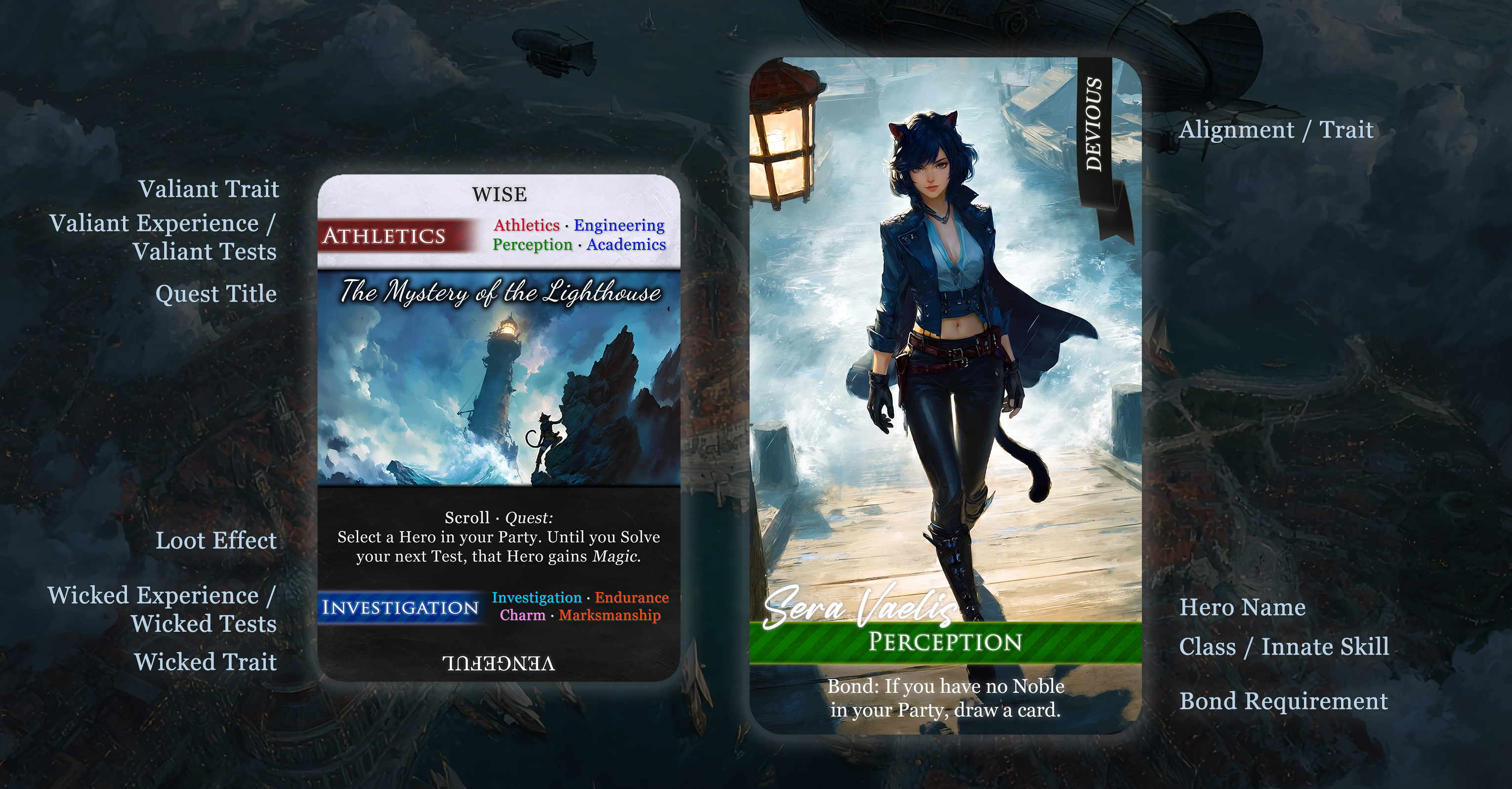
Illustration: example Quest card and Hero card
Every Hero also has a Bond ability that allows you to draw an extra card, and thus gain an extra point. These small extra points can add up during the game to a decisive advantage. These abilities always specify a Requirement you need to fulfill to trigger them.
Quest cards:
Quest cards have various purposes.
- Quest:
Their main use is to determine what Quest your Party of Heroes will undertake in the current Round. Each Quest can be solved in either a Valiant or a Wicked way. Both approaches succeed, but they require different Skills and grant different Traits (as reputation).
Each card shows two groups of four Skills: the light background is for the Valiant solution, and the dark background is for the Wicked solution.
- Experience: If, during a Quest, your Heroes will need to use a Skill for a Test that they don't innately have, you will be able to play the relevant Skill from your Hand if it's present on a Quest card either as a Valiant or a Wicked Experience.
- Loot: You can also play any card from your hand for its Loot effect, which is the text effect below the illustration.
Each Loot effect starts with a name, followed by a phase of the round when that card can be played. There are 8 different Loot effects, with 12 cards of each type. You will find some clarification about them at the end of the rules.
- Trait: After your Party solves a Quest, the Questgiver gains the card as a Trait. The player will place the Quest card under his/her Questgiver so that the relevant new Trait is visible in addition to previous ones. The newly solved Quest's Valiant/Wicked Trait side will depend on the method the Party used while solving it (see Traits).
- Victory Point: Last but not least, the Quest cards stand for Victory Points. Each card a player collects will be worth 1 Victory Point at the end of the game. So even if the card you draw is useless to you, at least it's worth 1 victory point!
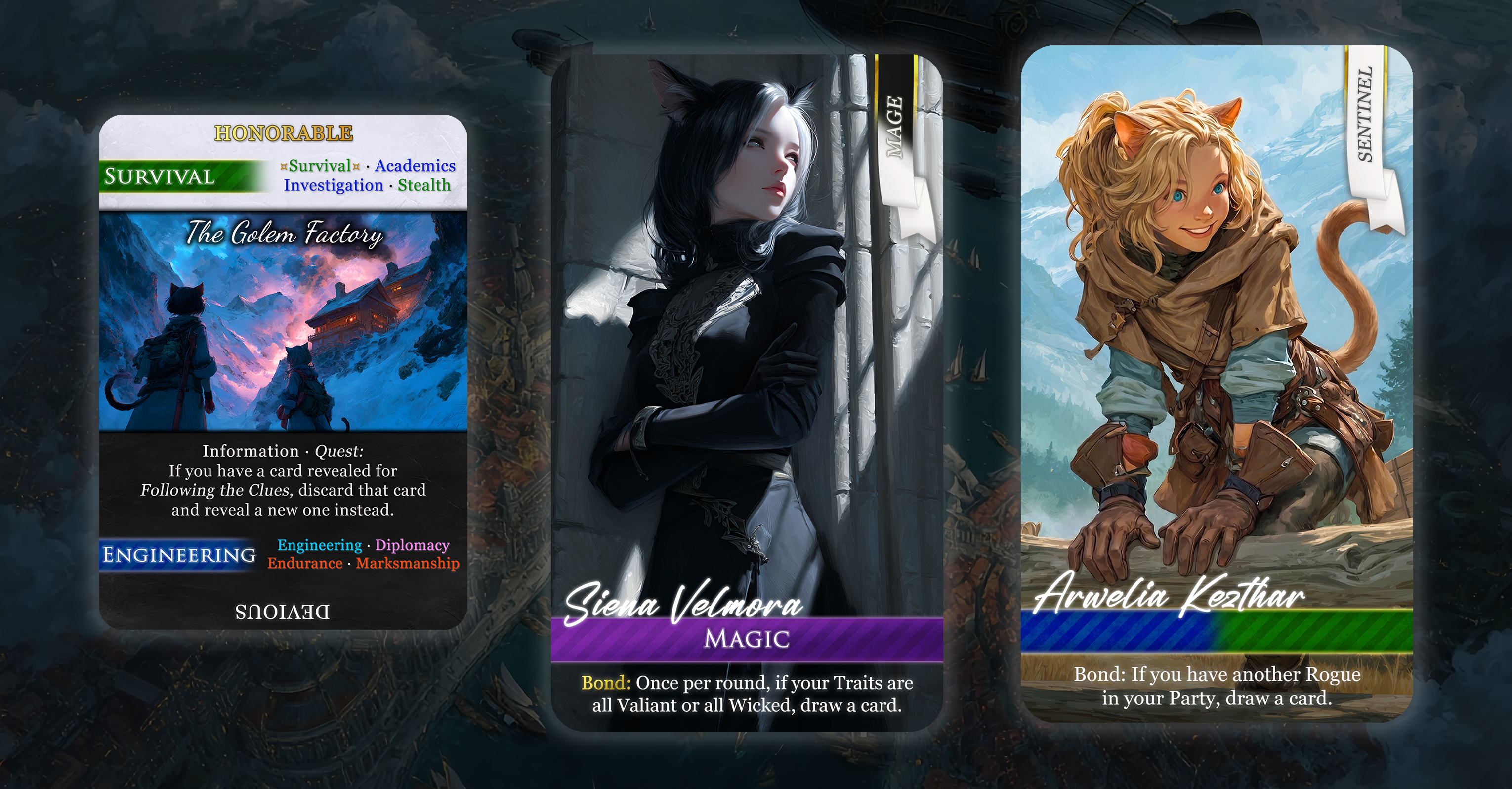
Illustration: a Quest with a Magical Trait and Magical Test, a Mage Hero (Noble), and a Sentinel Hero (Scholar + Rogue)
Traits:
During the game, sometimes you may "gain Traits". These always come from Quest cards, most often from a Quest you have just completed. In any case, place the Quest card behind your Questgiver so that only either the Valiant or the Wicked Trait is visible.
The Valiant Trait is on top of the card, with light background; the Wicked Trait is at the bottom of the card, with dark background.
As the game progresses, you will gain multiple Traits. Stack them behind your Questgiver, keeping only the chosen side of each card visible.
If you gain a Trait as a result of your completed Quest, its side is connected to the 4 Tests you solved: if you solved the Tests on the light side, you gain the Valiant trait of your Quest, if you solved the Tests on the dark side, you gain the Wicked trait of your Quest.
Valiant Traits: Wise, Merciful, Honorable, Loyal.
Wicked Traits: Ruthless, Vengeful, Ambitious, Devious.
Some of the cards have one or both Traits in golden letters. This indicates that the related side of the Quest contains a Magical Test. The Magical Test is always the first one in the list, marked with golden symbols. Solving a Magical Test is only possible with Magic present in your Party. They increase the difficulty of a Quest, but you can find some advantages to owning Magical Traits.
Trust:
A Hero "Trusts" you if your Questgiver owns the Trait that matches the Hero's.
A Mage Hero always Trusts you if you have any Magical Trait, either Wicked or Valiant.
Mages are pragmatic and don't care about your Alignment, as shown by their black + white banner.
(Exception: Mariel only Trusts you if you have a Valiant Magical Trait.)
Sentinels Trust you if you are the First Player.
Their duty is to protect the weak, and the First Player card will go to the player with the least Victory Points at the end of each round.
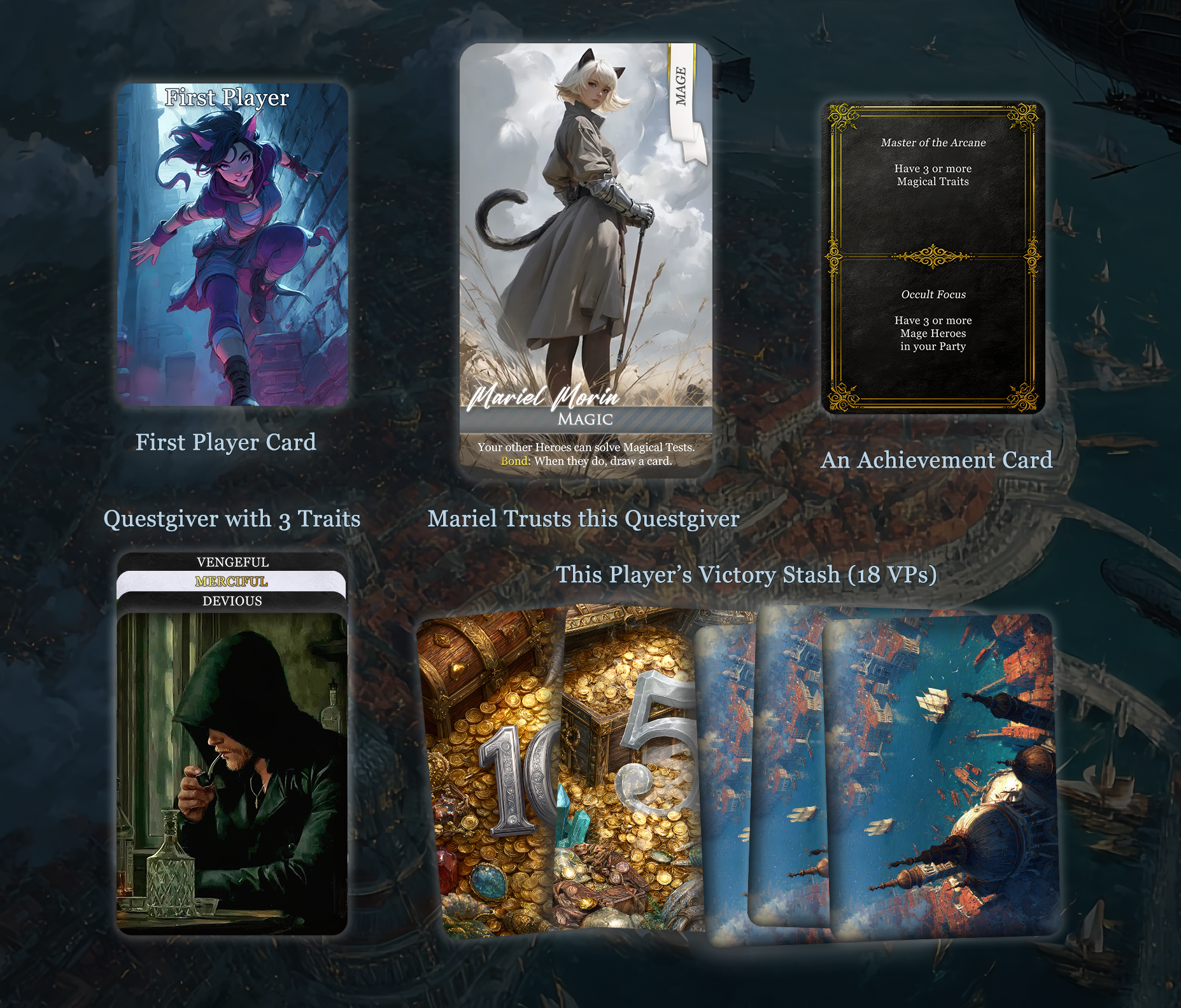
Illustration: a Questgiver with three Traits, the First Player card, his Victory Stash and an Achievement card
Hand Limit and Victory Stash:
In addition to their Hand of cards, each player has their own "Victory Stash", where they collect the cards that they have played as either Experience or Loot. Each card in this pile is worth 1 point at the end of the game. Collect the cards here face down. It does not matter which individual cards are in your Victory Stash, only the number of cards in this pile matters. Whenever you have 5 or more cards in this pile, exchange them for a "5 points" card and discard 5 cards from your stash. Exchange similarly "10 points" and "20 points" cards.
Each card you play from your hand either as Loot or Experience is placed in your Victory stash after their effects are resolved.
>>> Important: you can never have more than 6 cards in your Hand! <<<
If you already have 6 cards in your hand, and you are instructed to draw a card, place a card from the top of the Quest deck face down directly into your Victory stash without looking at it.
When a player would draw a card from the Quest deck, but there are no cards left in it: First, ask all players to exchange cards from their Victory Stash for "5-10-20 Points" cards, if possible. Place the exchanged Quest cards into the Discard pile. Then shuffle the Discard pile to form a new Quest deck.
When you are instructed to "discard a card", place it on top of the shared Discard pile, not in your Victory Stash.
Achievements:
You can claim an unclaimed Achievement card as long as you fulfill its requirements on either its top or bottom half, or both.
Timing: You can only claim Achievements during the Quest phase, or during the Aftermath phase before you discard Heroes.
If several players are trying to claim a card at the same time, the First Player takes priority, or the player closest to him in clockwise direction.
Take the card from the common area and place it in front of yourself. Other players can no longer claim that card.
One player can claim any number of Achievements during the game.
The claimed Achievement is not replaced. The only Achievements available are those revealed during Setup.
If you fulfill the requirements on only one side of the Achievement card when you take it, your draw 2 cards as a reward.
If you fulfill the requirements on both sides at the same time, draw 4 cards.
Setup
Separate the Heroes into 3 stacks:
1. Mage and Sentinel Heroes (12 cards)
2. Other Heroes with Valiant Alignment (16 cards)
3. Other Heroes with Wicked Alignment (16 cards)
Randomly select 8 Valiant Heroes and 8 Wicked Heroes.
Shuffle these together with the Mages and the Sentinels to form a Hero deck of 28 cards.
Place the remaining 16 Hero cards back into the box.
Shuffle the Quest deck and place it next to the Hero deck within reach of all players.
Deal 6 Quest cards to each player.
Give each player a Questgiver card. Players may choose either side (female or male).
Shuffle the Achievement deck and reveal cards from it equal to the number of players plus one. Place these within reach of all players.
Place the remaining Achievement cards back into the box.
Randomly choose a player to take the First Player card.
Finally, each player chooses a card from their Hand and gains it as a Trait, using either side.
Players can not choose a Magical Trait at this point. If by some astronomical chance a player only has cards that have Magical Traits on both sides, he immediately wins the game and start a new one.
Then the players draw a card to have 6 cards in hand again.
Turn Sequence
The game is played for 4 Game Rounds. All 4 Rounds have the following 3 phases:
1. Recruitment
2. Quest
3. Aftermath
1. Recruitment phase
At the start of each Recruit phase, shuffle the cards in the Hero deck, then deal out 4 Heroes to the middle of the table face up. The players will take Heroes from this display to add them to their own Party of Heroes. Each player's Party will consist of 4 Heroes by the end of the Recruit phase.
Starting with the First Player, each player will have his turn in clockwise order to recruit one or two Heroes at the same time from the display. The players will keep taking turns recruiting Heroes until everyone has 4 Heroes in their Party. Skip the turn of any player who already has 4 Heroes in front of them.
Note that it's possible that some players will already have Heroes in their Party left over from the previous turn.
When it's your turn to recruit from the display (and you don't have 4 Heroes yet), choose one of the following two options:
1. Take a Hero from the display and add her to your Party, or
2. Take two Heroes from the display, add them to your Party, then return a Hero from your Party to the display.
In both cases, refill the display up to 4 Heroes by drawing a new card face up from the Hero deck. Then it's the next player's turn to recruit.
When all playes have 4 Heroes in their Parties, discard the remaining Heroes in the display.
Then all players choose and reveal a Quest card simultaneously from their Hands and they place it in front of themselves. This will be their own personal Quest for this Round.
Finally, each player draws a card from the Quest deck in turn order to replace the one they just placed down in front of them.
With that, play now proceeds to the Quest phase.
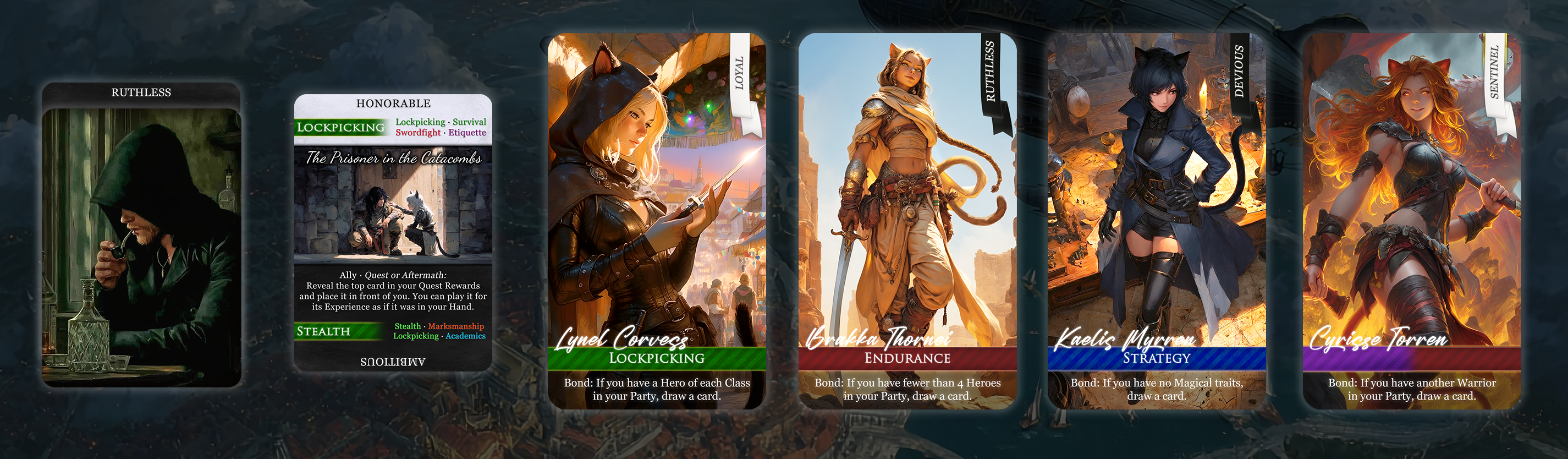
Illustration: John is planning to solve the Quest "The Prisoner in the Catacombs" with his Party in the Valiant way. Alas, the Innate Skills of his Party will not cover all 4 Tests in that group. Hopefully he has some tricks up his sleeve.
2. Quest phase
Players take turns resolving their entire Quest phase, starting with the First Player and proceeding clockwise. When all players have resolved their Quest phase, proceed to the Aftermath phase.
When you are the Active player, you must go through the following steps:
1. Announce if you are completing your Quest in a Valiant or a Wicked way. This will determine which group of 4 Tests you have to solve on your active Quest card.
2. Solve 1-4 Tests in your Quest in any order, from the group of 4 Tests that you chose in the previous step.
3. If you solved fewer than 4 Tests, you must give a chance to other players to Support you in the Tests you skipped.
4. Then you can optionally Follow the Clues and discover the root causes and masterminds behind your Quest, solving additional Tests one by one in a repeating "push your luck" manner until you decide to stop or you are forced to.
5. Finally, your Questgiver gains your current Quest card as Trait, with the side that you chose in the first step.
After these steps are completed, the next player in clockwise order becomes the new Active Player.
When each player had their turn as Active Player, the phase ends and the game proceeds to the Aftermath phase.
You can play Loot effects that can be triggered during the Quest phase if:
- You are the Active Player, or
- When it's your turn to consider Supporting another player in their Quest.
Solving a Test
Each Test requires a specific Skill. You can solve it in one of the following ways:
- Innate Skill: If a Hero in your Party has the required Skill as Innate Skill - she is able to solve the Test.
- Using Experience: If you have a Hero that belongs to the same Class as the Skill that is being Tested, she may use Experience.
To use Experience: play a Quest card from your hand that lists the required Skill either as Valiant or Wicked Experience. Place this card next to the Hero that uses it. The Hero must belong to the matching Class. If you do this, she solves the Test. The Experience only lasts for one Test.
Note that you must always point out the specific Hero that solves the given Test.
There could be several reasons why you would want to keep the Experience (or a Loot) you just played on the table - for a Bond effect, or for an Achievement -, but if there is nothing you want to prove by leaving the card visible, you can just immediately place it into your Victory Stash after playing it. If you choose to leave it out on the table, place it into your Stash at the start of the Aftermath phase.
When you solve a Test in your Quest, take the topmost card of the Quest deck and place it face down into a pile of "Quest Rewards". You will draw these cards into your hand in the Aftermath phase.
Magical Tests
You can recognize a Magical Test from the golden symbols next to the required Skill. It is always the first Test in the list (but you don't have to solve it first).
To solve a Magical test, you need to choose a Hero who has Magic. Mage Heroes have this innately. Otherwise, you may play a card with a "Scroll" Loot Effect to give a Hero Magic temporarily for the duration of your next Test. Then you may still play Experience if the chosen Hero does not have the required Skill itself innately. Without Magic, your Heroes can not solve Magical Tests.
Doubt
Each time after one of your Heroes solves a Test for any reason, you need to check if they are okay with your plan or if they start doubting your decisions.
Go through these steps after every Test you solve:
1. Does the Hero who solved the Test Trust you? If she does, then she does not Doubt you and you can skip the rest of these steps.
If that Hero does not Trust you:
2. Is the Test itself on the side of the Quest card that opposes her Alignment? Eg. is the Quest being completed in the Valiant way and the Hero is Wicked, or vica versa? If so, then the Hero now Doubts you.
3. If you played an Experience to solve the Test, does that Experience oppose her Alignment? If so, then the Hero now Doubts you.
Remember, Experience also has Valiant or Wicked Alignment, depending on which side of the card it is on.
If the Hero has no Doubt, you can proceed with your turn as normal.
However, if the Hero has Doubt, you must either:
- Place a card of your choice from your Hand directly on top of your Victory Stash face down, or
- Discard that Hero from your Party.
Note that Mages who have both the black and white colors in their banners never Doubt you.
Support
If you still have Unsolved Tests when you announce that you are not going to solve any more of the 4 Tests on your Quest card, your opponents have a chance to send Heroes to solve them instead of you.
Starting with the player to your left and proceeding clockwise, each opponent has a chance to Support you in any Tests that are still left unsolved:
- That player may select one or more unsolved Tests in your Quest and solve them one by one, using the Heroes in their own Party, and potentially by playing cards from their own Hand. Any Test that gets solved remains Solved for the rest of the Round - other players now can not Support you in those.
- If that player decides to not Support you in any more Tests, and your Quest still has unsolved Tests, then the next player now has a chance to solve any Tests that remain, and so on, until all 4 of those Tests are solved or each player passes.
- The controller of the Hero that Supports you draws a face down card as Quest Reward for each Test they solved instead of you.
The controller of any Supporting Hero will need to make a Doubt check as well, considering their controller's Traits and the Alignment of the Test they solved. Of course it will be their controller who will need to place a card from their Hand into their own Victory Stash if they don't want to discard a Doubting Hero.
Supporting is always optional.
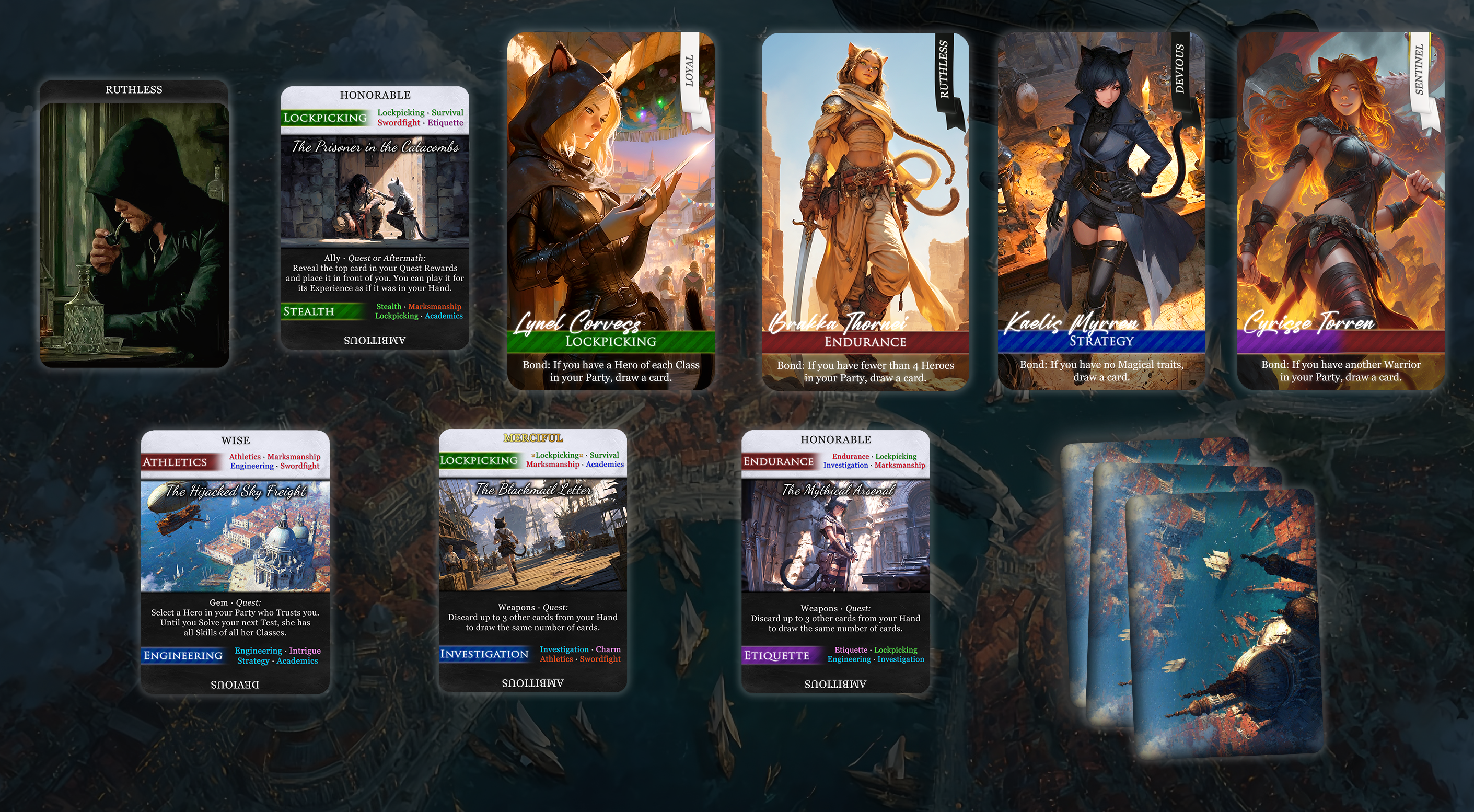
Illustration: one player's Quest phase, see example below.
An example Quest phase:
John becomes the Active Player in the Quest phase.
His Current Quest is "The Prisoner in the Catacombs". He announces that he is choosing the Valiant approach to solve it.
The Valiant side of this Quest lists these 4 Tests:
Lockpicking, Survival, Swordfight, Etiquette
1. Lynel Corvess in John's party has Lockpicking as her Innate Skill. So John just points at her and announces that she is now solving the Lockpicking Test.
Lynel is Valiant, and John is solving the Quest in a Valiant way, so she has no Doubts about this.
John draws a card face down from the Quest deck and places it into his newly started Quest Rewards pile.
2. Next, John points at Brakka Thornei. Her Trait is Ruthless, and John also has the Ruthless Trait. So Brakka Trusts him. John now plays a card from his Hand for its Loot Effect:
"Gem - Quest: Choose a Hero in your Party. If she Trusts you and she is of the same Class as your next Test, she solves it automatically."
John announces that he is choosing the Swordfight Test for Brakka to solve now, which she does, thanks to the Gem he played, since she is a Warrior, and it is a Warrior Test.
Since Brakka Trusts John, no Doubts enter her mind, even though she has just solved a Test in the Valiant way, in spite of her own Wicked Alignment.
John draws another card into his Quest Rewards pile.
3. John still needs to solve a Survival and an Etiquette Tests. He has no Heroes with these Innate skills, but he does have a Rogue and a Noble in his Party, so he might be able to solve these through Experience.
Unfortunately, he has neither Skills as Experience on the cards in his Hand. So he plays a "Weapons" Loot Effect from his hand, which says:
"Weapons - Quest: Discard up to 3 other cards from your Hand to draw the same number of cards."
He places the Weapons card on his Victory Stash, then discards 3 cards from his Hand into the common Discard pile. Then he draws 3 cards from the Quest deck.
Unfortunately, he did not draw any Survival, but he did draw a card with Etiquette Experience ("The Mythical Arsenal").
So he plays this card as Experience for Cyrisse Torren, since she is a Noble and she can use Noble Experience.
The Etiquette test is now also solved. However: Cyrisse is Valiant, and John just made her use a Wicked Experience. So Cyrisse is now Doubting John.
John considers discarding her from the Party, but he has the Requirement for her Bond ability, which will gain +1 VP for him in the Aftermath phase. However, if he does discard her, he will then fulfill the Requirement for Brakka. So in the end he decides to actually discard Cyrisse from his Party.
For the third solved Test, he draws another card into his Quest Rewards pile.
4. He now announces that he is not able to solve the remaining Survival Test. He asks the player on his left, Anna, if she is able to Support him in this.
Anna actually does have a Rogue Hero in her Party and she plays a Survival Experience from her Hand to Support John in this Test.
Since that Hero is of Wicked Alignment, and Anna has just solved a Test on a Quest's Valiant side, the Hero now Doubts Anna. Anna chooses to place a card from her Hand onto her own Victory Stash to keep the Hero in her Party.
She then also draws a face down card from the Quest deck and places it on her own Quest Rewards pile.
With that, there are no more unsolved Tests in John's Quest, so he can proceed with his turn.
Following the Clues
After you and your opponents have finished solving Tests on your Quest card, you can decide to look behind the curtains and face new, random Tests one by one. You can only solve up to 3 extra Tests this way in one round.
Repeat these steps until you decide to stop, or until you are forced to:
1. Decide if you want to continue or stop. If you already solved 3 Tests this way, you must stop now.
2. If you continue, reveal the top card of the Quest deck.
3. Solve any of the two tests present as Experience on the revealed card.
You are free to play cards from your Hand for their Loot effects or for Experience for this Test, as usual.
- If you can Solve this Test, you have to check if the Hero who solved it has Doubt, taking into consideration the Experience if you played any, and the Alignment of the Test you chose to solve (if it was on the revealed card's Valiant or Wicked side).
The way you solved your original Quest no longer matters here.
Deal with the Doubt if it arises, then go back to step 1 and decide if you want to continue this process.
- If you can not (or don't want to) solve either of the two Tests on the revealed card, you must Stop Following the Clues entirely.
If you are forced to Stop in this way (that is, you did not Stop at step 1), you must discard a Hero of your choice from your Party of a specific Class:
- Look at the Valiant and Wicked Experiences on the revealed card. You must discard a Hero from your Party that belongs to either Class of those Experiences.
- If you don't have any Hero that belongs to either Class, discard any Hero of your choice from your Party.
This test may also be Magical: if the Experience you choose as Test on the revealed card is on the side of a Magical Trait (the first test on its side is Magical), then you will need Magic to solve it.
When you solve a Test during "Following the Clues", set the card aside. After you are finished with "Following the Clues" altogether, place these set aside cards straight into your Victory Stash.
Do not place these cards into your Quest Rewards pile!
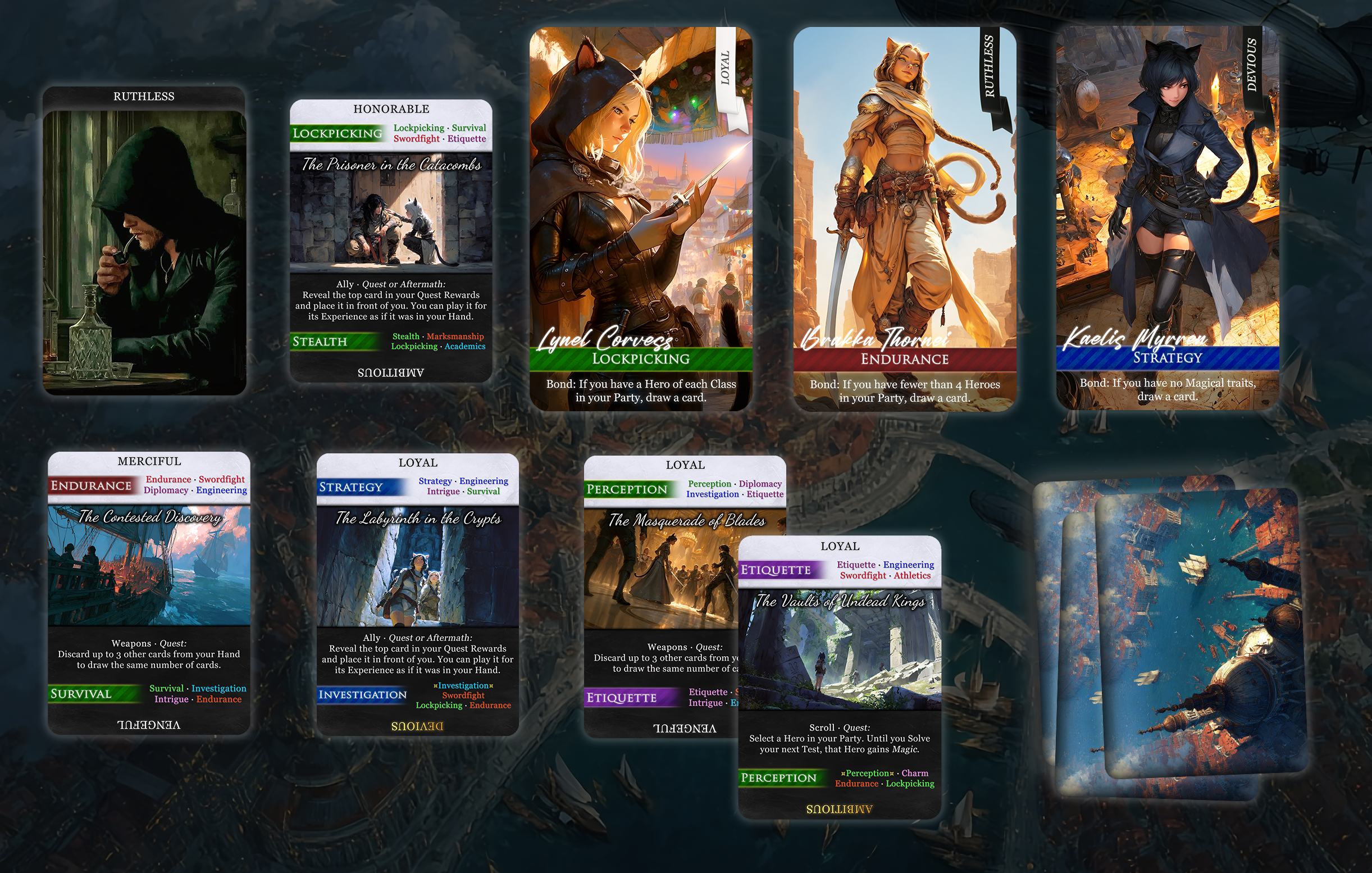
Illustration: John is now Following the Clues, see example below.
An Example for Following the Clues:
John still has 3 cards in his Hand, so he decides to Follow the Clues of his Quest.
1. He Reveals the top of the Quest Deck: It is "The Contested Discovery", with a Valiant Endurance Test and a Wicked Survival Test.
He chooses the Valiant Endurance Test, and sends Brakka to solve it. Even though the Test is Valiant and Brakka is Wicked, she Trusts John so she doesn't say a word of Doubt.
(To tell the story: it seems like the Prisoner ended up in the Catacombs due to a Contested Discovery.)
John turns the card face down and decides to keep Following the Clues.
2. He now reveals "The Labyrinth in the Crypts". It has a Valiant Strategy Test and a Wicked Investigation Test.
Kaelis Myrren does have Strategy as Innate Skill, but she is Wicked. John sends her to solve this Test, but she raises some Doubts about this choice.
John places one of his cards from his Hand on top of his Victory Stash to keep Kaelis in his Party.
(Apparently, the clues to the Discovery were originally hidden in the labyrinth.)
John still has 2 cards in his Hand. He turns the previous card face down and decides to keep pushing his luck.
3. He now reveals "The Masquerade of Blades", with a Valiant Perception Test and a Wicked Etiquette Test.
Lynel is a Rogue and John does have a card with Perception Experience in his Hand ("The Vaults of Undead Kings").
So John sends Lynel to solve this Test by playing this Experience.
However, even though the Test itself was Valiant, the Experience he played was Wicked. The Valiant Lynel raises an eyebrow of Doubt over this choice.
John wants to keep her in the Party, just in the hope that she can still Support another player this Round - he can see that all of their Quests have Lockpicking tests, and they have no Heroes with this innate Skill. So he places the last card from his Hand on top of his Victory Stash to keep Lynel from leaving due to Doubt.
(The clues point to how our Prisoner was betrayed by someone during a masquerade.)
John now must stop Following the Clues, having solved 3 Tests already this way.
He collects the 3 cards he revealed for these Tests and places them face down on top of his Victory Stash.
This concludes his adventure.
Finally, John places his original Quest, "The Prisoner in the Catacombs" behind his Questgiver card, with the "Honorable" Trait visible.
With that, John's Quest Phase is now finished, and Anna becomes the Active player.
Sentinel Bonus
Whenever you play a card as Experience for one of your Sentinels:
If that card has 2 different colors for Wicked and Valiant Experience, and those two colors match the two Classes of that Sentinel, you can immediately draw a card (before Doubt).
Gain your Quest as Trait
The final thing you do as Active Player in the Quest Phase is to take your active Quest and gain it as Trait with the side which you chose for your group of Tests. Place the Trait behind your Questgiver to form a column with previously gained Traits, so that all of them are visible.
Exception for Magical Tests: if your Quest had a Magical Test and you yourself did not solve that specific Magical Test, then instead of gaining your current Quest card as Trait, put it into the Discard pile, then reveal the top card of the Quest deck, and gain that card with the same Alignment as Trait.
(If it is also Magical, discard that card too and repeat the process.)
You only deserve a Magical Trait if you have actually solved a Magical Test during your Quest.
3. Aftermath phase
At the start of the Aftermath phase, if you still have cards on the table which you played as Experience or Loot, place them into your Victory Stash now.
Players then take turns resolving their entire Aftermath phase one by one, starting with the First Player and proceeding clockwise.
There are 3 steps in this phase:
- Check for Bond Requirements,
- Gain Quest Rewards,
- Discard Heroes.
After each player goes through the steps above, they check for a new First Player.
When these steps are resolved, start a new Round. In the 4th Round, skip the "Check for new First Player" step and proceed to the game end.
Bond
In the Bond step of the Aftermath phase, the active player checks if the Heroes remaining in their Party can trigger their Bond effects. Bonding with a Hero depends on some Requirement you need to fulfill, and it lets you draw a card as reward.
You can resolve the Bond abilities in any order of your choice.
The Mages are an exception from this rule, because their Bond abilities can be triggered during the Quest phase. This is emphasized by having the word "Bond" in a golden color in their text box.
If you want to mark which Mage has already triggered her Bond ability, rotate her card to make sure you don't forget.
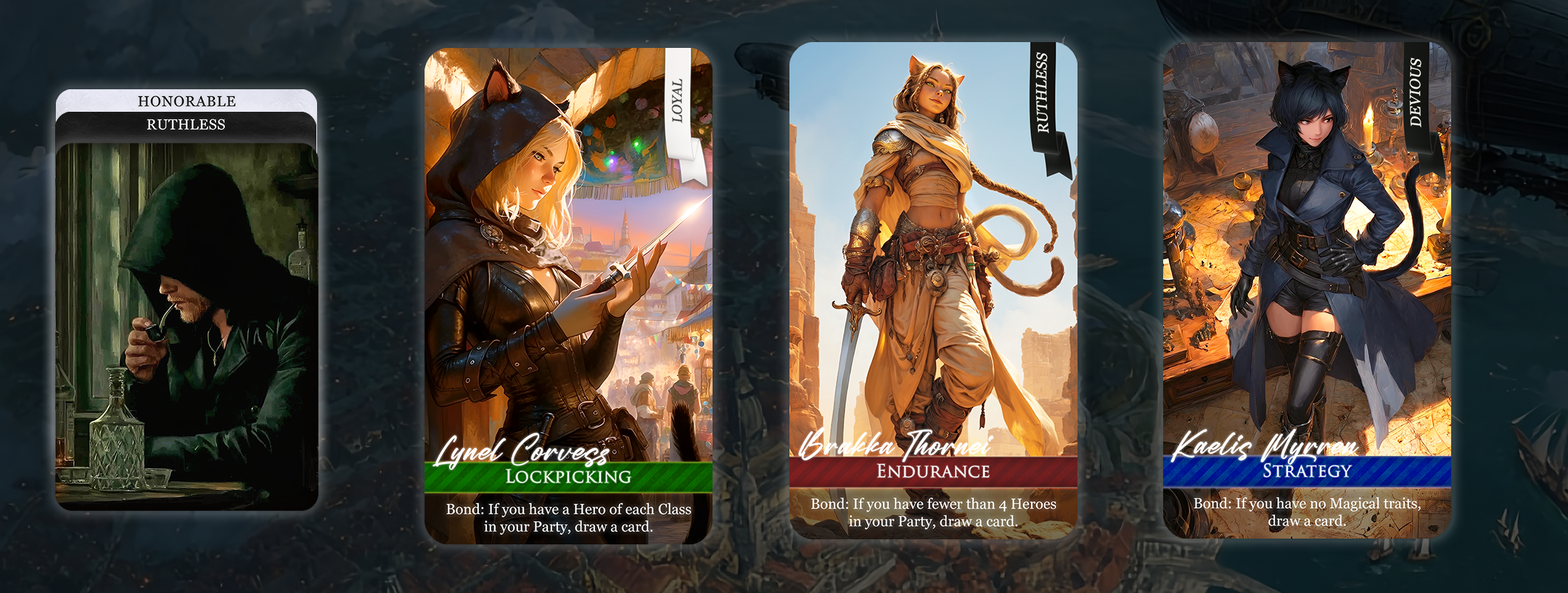
Illustration: Bonds
Bonding example:
Now it is the Aftermath phase. John looks through her Heroes and says:
"Lynel asks me to have a Hero of each Class. I should have kept Cyrisse in the Party, then I could trigger this, she was my only Noble! Too bad."
Then he continues,
"Brakka is happy when there are fewer than 4 Heroes in the Party. That is the case now, so I draw a card."
Finally he looks at Kaelis:
"I have no Magical Traits. Kaelis likes that. I draw another card."
Gain Quest Rewards
You gained face down cards during the Quest phase into a Quest Reward pile. Draw those cards now, one by one, as if you were drawing them from the deck.
As soon as you already have 6 cards in your Hand, place the rest of the Quest Reward cards directly on top of your Victory Stash.
Note that the you can immediately play any card you draw for its Loot effect.
If you draw an Ally card while you draw your Quest Rewards one by one, you can play it before you continue drawing the rest of the cards.
Discard Heroes
In this step, you must discard all the Heroes that do not Trust you from your Party.
You can Keep in your Party for the next Round any Hero that Trusts you, but you can decide to discard any of these too, to make room for new Heroes.
(In the final Round you will want to Keep every Hero who Trusts you, because you get Victory Points for them.)
Then if it's not the 4th Round, shuffle every Hero card left in the draw pile together with those in the Discard pile and form the new Hero deck for the next round.
Check for new First Player
Skip this step in the 4th Round!
In Rounds 1-3, count the number of Victory Points at this moment in each player's Victory Stash. The player with the fewest Points becomes the new First player.
In case of a tie, give the First player card to the player closest to the current First player in turn order. (If the current First player takes part in the tie, he should pass on the First player card to another player.)
Make sure that each player exchanges cards in their Victory Stash for "5-10-20 point" cards, if applicable, to have as few individual cards locked up here as possible.
Game End
When the 4th Round is over, the game ends.
Each player places every card left in their Hands into their Victory Stash.
Then, count up the Points in each player's Victory Stash.
Finally: Each player gains 3 extra Victory Points for each Hero that is in their Party at this moment.
Maybe the real treasure was the friends we made along the way...
The player with the most Points wins!
Some cards in detail
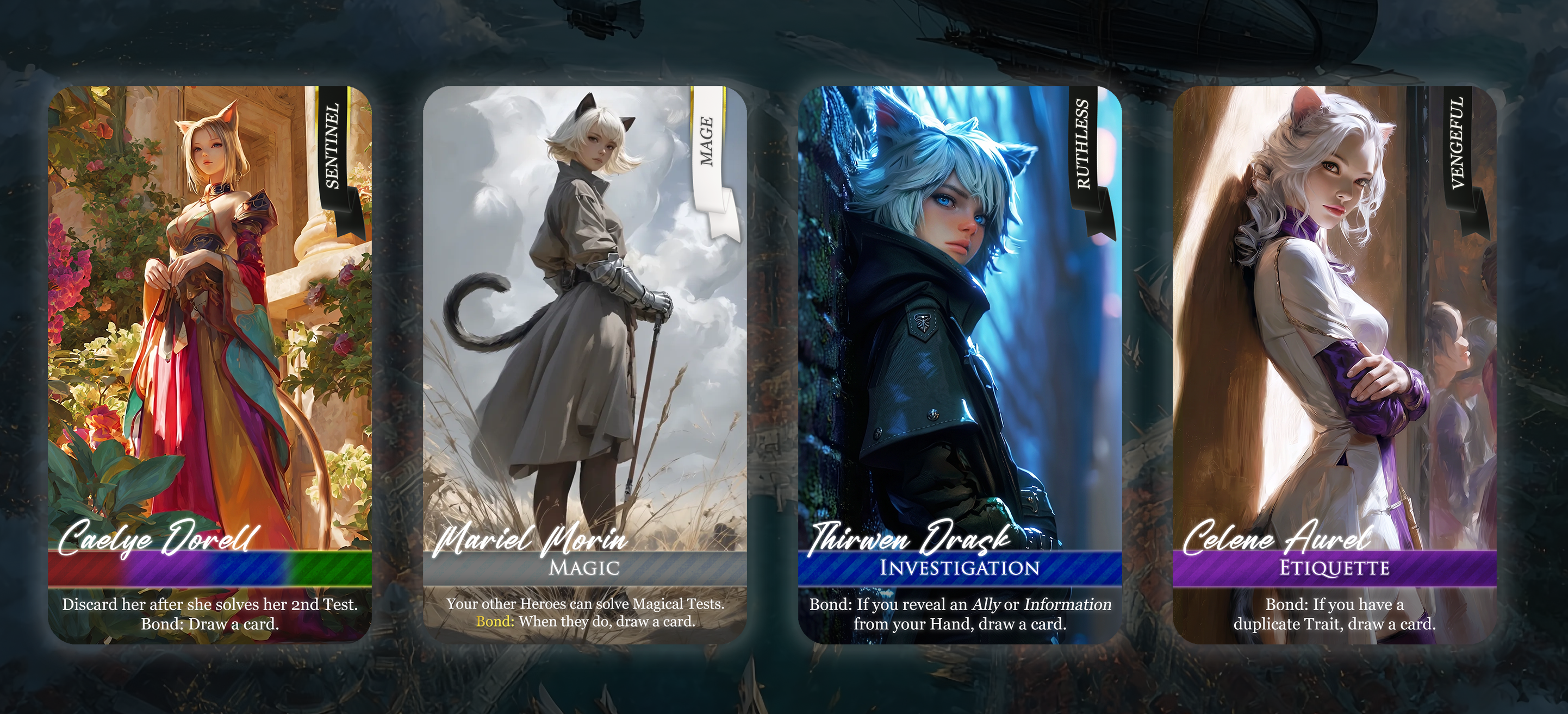
Caelye Dorell
She is a Sentinel who belongs to all 4 Classes.
Her Bond reward does not have a Requirement, you just need to make sure she stays in your Party.
She gives you the Sentinel Bonus for any 2-colored Experience you play for her.
Mariel Morin
She does not belong to any Class. Thus, she can only solve any Test with the use of a "Potion".
However she enables all your other Heroes to solve Magical Tests as if they had "Magic" themselves.
Her ability is the only one that can trigger multiple times in a Round, if you solve more Magical Tests during Support and Follow the Clues.
As mentioned before: as opposed to other Mages, she only Trusts you if you have a Valiant Magical Trait.
Heroes with "Reveal" in their Bond ability
These Heroes give you their Bond reward if you reveal a card (or more) from your Hand.
Place the card back into your hand after revealing it.
The order of triggering Bond abilities in your Party may matter here, since you can get lucky and draw the needed card from another Bond.
Celene Aurel
Two traits counts as a "duplicate" even if they are the same trait, but one version of it is basic and the other is Magical.
Loot Effects
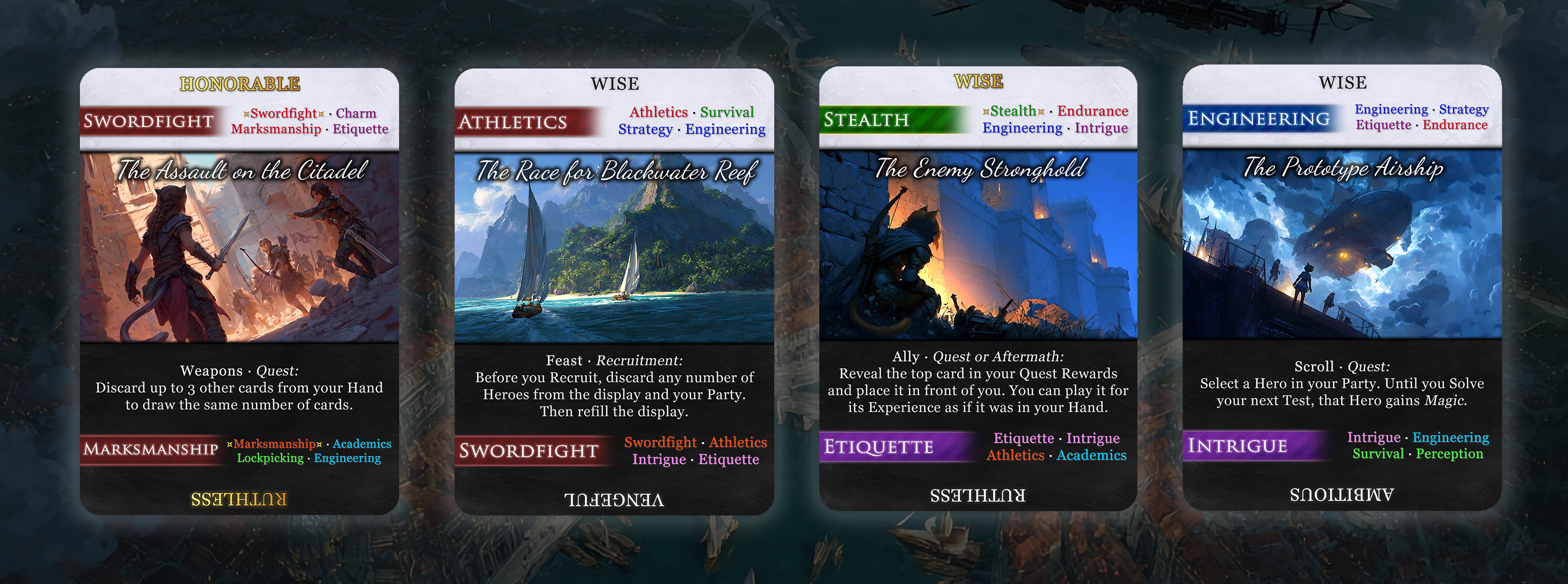
Weapons
When you play a Weapons, place the Weapons card itself into your victory Stash, then discard up to 3 other cards from your Hand straight into the Discard pile.
You can choose to discard 0 cards.
Feast
If you already have 4 Heroes in your Party and you are skipped during the Recruit phase, you are not allowed to play this card.
Ally
You can only play this card when there is at least 1 card in your Quest Rewards pile.
Keep the card that you reveal with the Ally effect in front of you. Make sure you visibly separate it from the area where you play Experience and Loot, not to accidentally place it into your Victory Stash.
The revealed card stays in front of you - as if it was in your Hand - until you play it, even through several Rounds. It does not count into your Hand Limit. You can not use its Loot effect.
When you take your Quest Reward cards one by one into your hand during Aftermath, you can play an Ally between drawing cards.
You can have any number of such revealed cards in front of you.
When the game ends, place these into your Victory Stash - they count for your Victory Points.
Scroll
If you want to Solve a Magical Test, you can play a Scroll to allow a non-Mage Hero to solve it.
You can play an Experience together with the Scroll card and solve the Test that way if you wish.
You are allowed to play this even when you face a non-Magical Test (if you just want to get rid of it from your Hand). That will not trigger Mariel.
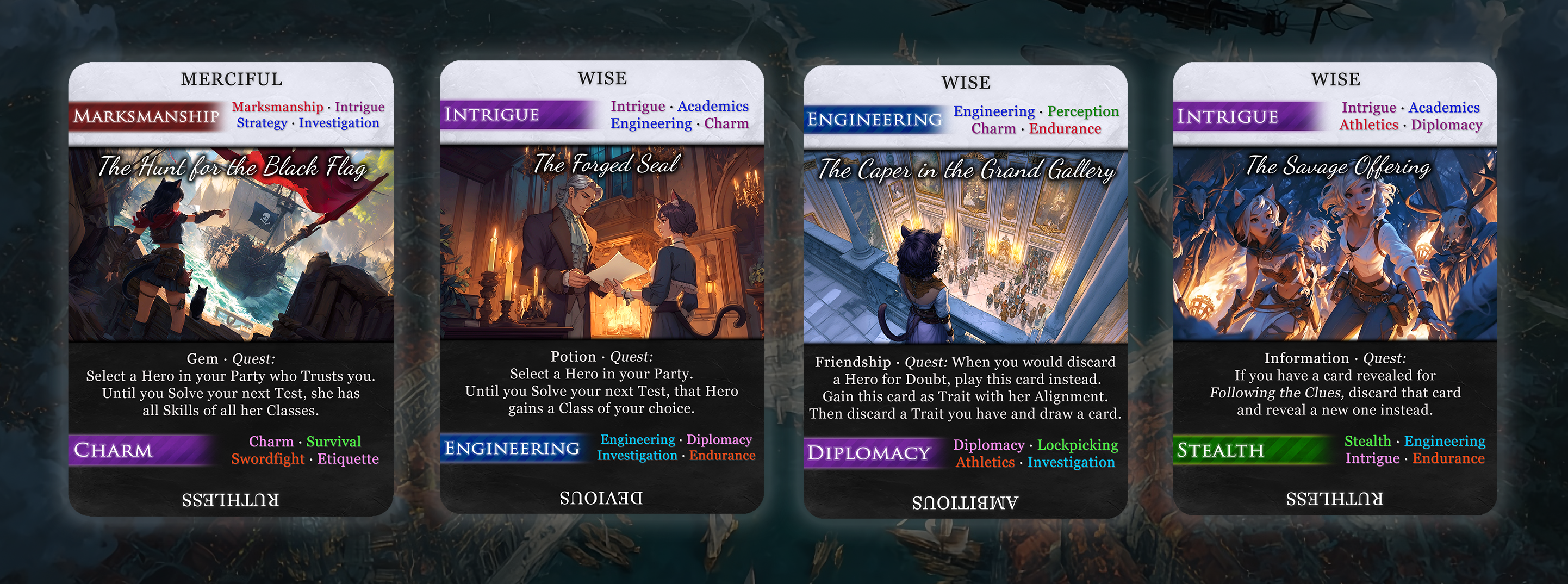
Gem
Gem lets you solve a Test, but for a Magical Test, you still need to use Magic somehow, either by playing a Scroll, or playing the Gem for a Mage Hero. (Or by having Mariel in the Party.)
You will still need to check for Doubt after playing a Gem.
Potion
This lets you play an Experience of the chosen Class from your Hand to use with the selected Hero.
You can also combine this effect with a Gem.
This does not make her a Sentinel (if she isn't already).
If you don't solve any more Tests this Round, you lose the effect at the end of the current Quest phase. (The same is true for Gem and Scroll.)
Friendship
If you play this card, don't discard the Hero for Doubt.
After playing it, add it to your Questgiver's Traits with the side that matches the Hero's Alignment. Then you can choose any card your Questgiver already has for Trait and discard it. You are allowed to choose the same card you just gained, if you only wanted to play it without keeping it.
Information
During the Following the Clues step of the Quest phase, you can play this card to get a second chance at a card reveal.
This does not count into the 3 limit for Following the Clues.
Achievements
Having Traits with Experience
You are considered to have a "Trait with (eg.) Rogue Experience", if a card behind your Questgiver as Trait shows a Rogue Skill either as Valiant or Wicked Experience.
Even if both Experiences are of the required Class, count one card only once.
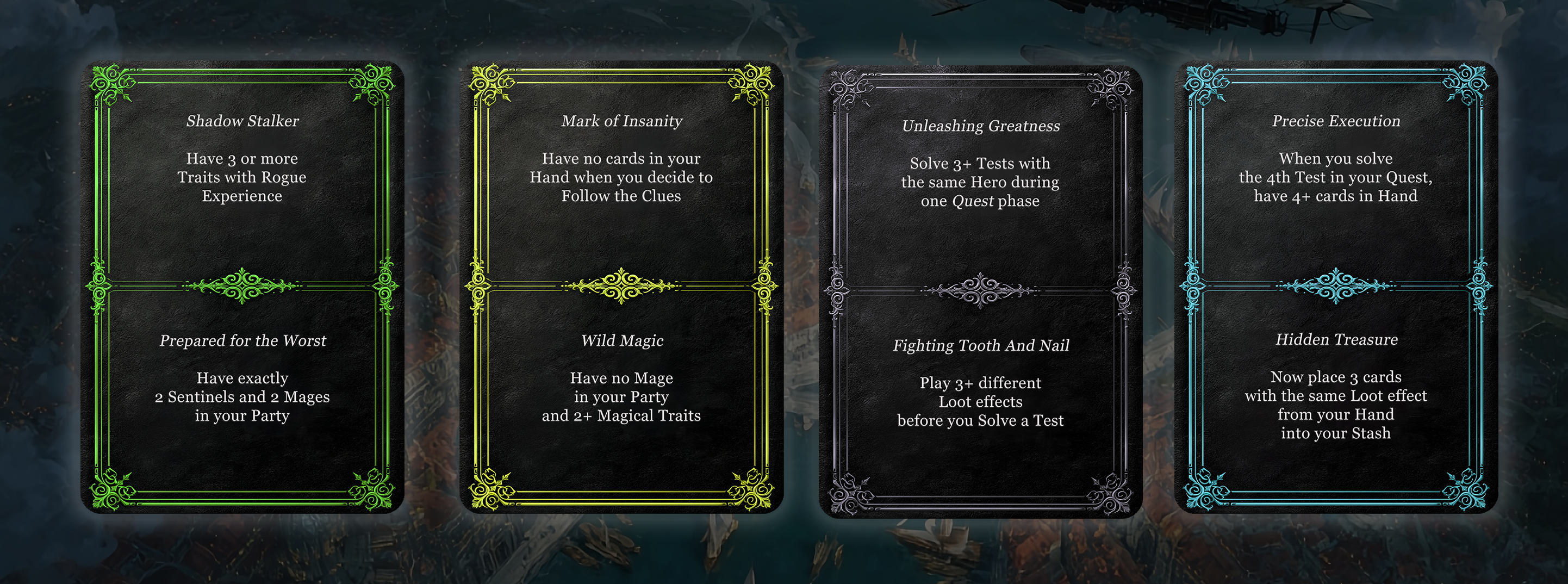
Timing
If an Achievement is tied to a specific point in time (eg. "at the start of Aftermath", or "when you solve your 4th Test", etc), you can only claim it at that exact time, you can not point at it retroactively and say "I was fulfilling the requirement at that point".
You are allowed to claim "Precise Execution" and "Hidden Treasure" at the same time, showing the cards first then placing them into your Stash.
Mark of Insanity
The cards you have in front of you from Ally loot effects don't count as being in your Hand for this Achievement.
After you reveal the new card for Following the Clues, you can claim this Achievement before you solve any Tests on it.
Fighting Tooth and Nail
Playing the cards for their Loot effects is required directly before you solve a Test, with no other Test you solve between playing the cards.
The timing for claiming this Achievement is when you solve the Test if you played 3+ Loot before solving it. This way you can claim it together with its other side if it is the 3rd Test solved by the same Hero.
If you play a Friendship to make a Hero stay in your Party, that cardplay happens after she solved that Test.
Precise Execution
"The 4th Test in your Quest" is specifically the 4th Test written on your Active Quest, not a test you make while you "Follow the Clues".
Hidden Treasure
Don't trigger the Loot effects of the cards that you place into your Stash for this requirement.
Spellsword
The magical Test must be in the side you chose (Valiant/Wicked).
Solo Play
Achievements:
During Setup, reveal 2 Achievements.
During Rounds 1-3, you can complete either or both sides of these Achievements. However, during the 4th Round, you can only claim an Achievement if you can fulfill both sides at once.
First Player:
You count as being the First Player during the 2nd and 4th Rounds.
Recruitment:
Each time you would refresh the Display, discard every remaining Hero in it and reveal 4 new ones from the deck.
Following the Clues:
You can only decide to Follow the Clues if you have solved at least 3 Tests in your Quest.
Try to gain the highest score possible!
A score of 55 or higher is exceptional.
Online Solo game by Claude:
https://zais.hu/catgirlheroes/solo/